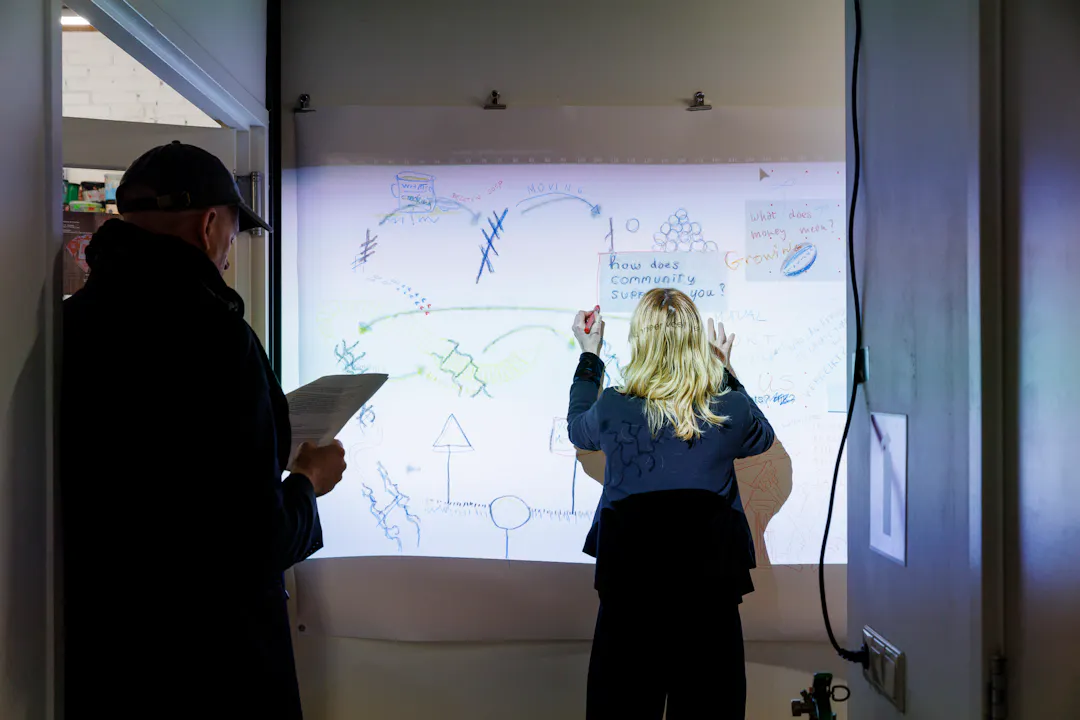
De resultaten van de vierde Ploegendienst, onderdeel van het programma H0ha.
Ploegendienst 4 | Rizqita Naherta, Not Just a Collective & ROTS
Working period: September - December 2025
Winter Gather Together: 9, 12 and 13 December 2025
On show: January 5 - February 21 2026
Part of the H0Ha programme, curated by the Sunflower Soup collective for Plaatsmaken, Arnhem.
These are the results of the fourth work shift of the multi-year program H0Ha. In H0Ha, the workshops of Plaatsmaken are used to experiment with forms of protest and resistance, through images and language. Poets, visual artists, activists, and publishers are invited to collaborate at Plaatsmaken in so-called ‘Shifts’. H0Ha is curated by the Sunflower Soup collective.
PLOEGENDIENST 4: S.T.W.iTCH
Did you have a grandmother who knitted socks for you? Did she teach you how to do it? And do you have the patience for that time-consuming work?
Handicrafts, such as crocheting, knitting, and sewing, have traditionally been seen as work done by women. It is labor that is often performed at home or in small communities. The maker often remains unpaid and unnamed. This fits into a broader pattern in which women's work is made invisible. At the same time, this labor forms a basis for women to come together, organize, and emancipate themselves.
The Arnhem collective Not just a collective has transformed handicrafts into graphic work. It is precisely this translation that creates a new visibility that makes it possible to reflect on these aspects of handicrafts. Handicrafts are often seen as old-fashioned, but they also carry a history of subversion, resistance, and solidarity.
The artist Rizqita Naherta created an installation that refers to women's emancipation in Indonesia and the important role that the Gerwani movement played in it. This movement is an example of how different forms of emancipation and resistance come together and reinforce each other, because anti-imperialism and decolonization were central to Gerwani. The silkscreen prints feature texts from Gerwani's magazine Api Kartini, printed on images of kebayas (traditional Indonesian clothing for women).
In the practice of artist and poet ROTS, “unravelling” is an important method that is used in both a concrete and metaphorical way: wool from old jumpers is reused for objects with other purposes. A seemingly familiar concept such as “man” is unravelled in order to question what masculinity actually consists of. ROTS created a man cave printed with images of Androgel, a hormone treatment. How should a man behave in his cave? You are welcome to find out for yourself by taking place in the soft interior of this cave, which can also be seen as a manwomb.
ABOUT THE PARTICIPANTS
Not Just a Collective
What does it mean to pass on handworking techniques in the modern world? Who taught you how to crochet, knit or work with textiles? Did the women you knew mostly do this for leisure, or was it the only work available?
In this textile work, five members of Not Just a Collective — Lu Lin, Femke Kersten, Alessandra Varisco, Doga Gönüllü and Heike Renée de Wit — started from the knowledge and techniques they had learned from their grandmothers. They shared their crochet and knitting skills with each other and with their neighbours at De Nieuwe Hommel community centre. By combining stories and memories from their grandmothers, they translated textile crafts into prints. Using printing techniques such as silkscreen and monoprint, these images were printed onto textiles which were then pieced together. This patchwork is on display in the middle of Plaatsmaken's space. You cannot miss it! The work reminds us of the labour, knowledge and stories of our grandmothers, and of the value of these aspects, which should not be forgotten.
Rizqita Naherta
Merawat Api dari Penyihir-Penyihir Militan Kami - Nurturing the Fire of Our Militant Witches
Through the assemblage of archives reactivated from Gerwani’s magazine Api Kartini, the excerpts from the magazine are presented on the many kebaya prints and the bamboo mats within the living room space, as revolutionary passages, poem, and list were recited through the phone and television by exiled relative.
The work holds a space of remembrance for the militant women’s mass organization. Along with the pedagogical activation, the work asks to nurture the memories of Indonesian women’s resistance, and their methods of understanding that are organizing with the masses that is prone to be forgotten in the present, as a result of the historical trauma under Suharto’s regime.
ROTS
Mancave / womb
hello I'm a performative male
my mancave is a womb
Dear Virginia, I'm now squatting the room, owning the room, making the room. The that became the (on steroids).
My body on testosterone feels more and more like my own, literally better, stonger. Was it only hormonal dysfunction? Did i just not have enough?
I know the moon, even so far away, was too much for me.
Do I feel more masculine because I'm taking testo or am I masculine and therefore I take testo?
masculinity is transforming
masculinity is tender and often fragile
masculinity relies on stories we tell about how men come into being.
Am I becoming a man by performing the same act again and again and again? I'm never quite reaching, quite being but probably for the better.
Gender is image perpetually cited, repeated, and reproduced. (J. Butler)
this mancave/womb gives shelter to ideas of performative masculinity exposing what Butler calls the machinery of becoming.
Becoming by performing.
my manwomb - an ode to my muses: the matchamen, the soyboys, the softbois, the metromen, the dandies and the hipsters.